Most sellers spend weeks deciding on a listing price. They interview agents, research comps, time the market. And then, on the day of the photography shoot, they rush around the house for forty-five minutes, shove things in closets, and call it done.
That’s the part nobody talks about, and it’s the part that quietly kills otherwise good listings.
Here’s the reality of selling a home in Tampa Bay right now: buyers are making decisions on screens, often from other states, often without ever setting foot in the property. A buyer relocating from Boston or Chicago is scrolling Zillow on a Tuesday night, and they’re not giving your listing more than a few seconds before they decide whether it’s worth their time.
What they see in those seconds: not the price, not the description, not the neighborhood; is the photography. And photography only looks as good as what’s in front of the camera.
Staging for a photo shoot isn’t the same as cleaning your house. It isn’t the same as staging for an open house, either. It’s a specific skill with a specific goal; making your home look the way buyers want to feel when they imagine living there. This guide shows you exactly how to do it, room by room, with the nuances that matter specifically in Tampa Bay’s market.
Understand What the Camera Actually Does to a Room
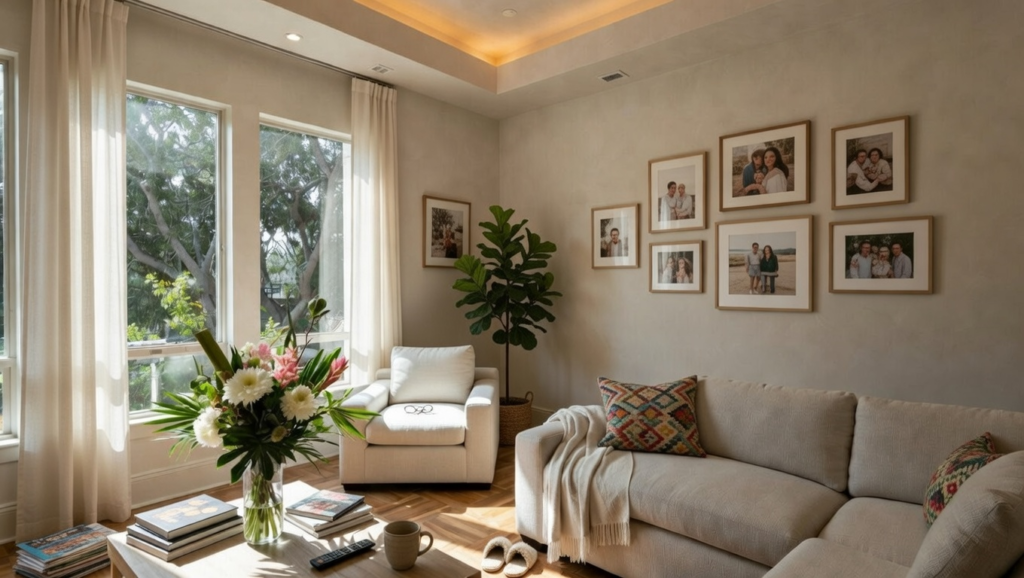
Before you touch a single throw pillow, it helps to understand what professional real estate photography actually does, because it behaves differently from how you see a room with your own eyes.
A wide-angle lens, which is standard for real estate photography, makes rooms look larger but also exaggerates depth. That means clutter at the back of a room looks further away but also more prominent. An unmade bed at the far end of a master suite isn’t a background detail, it anchors the entire frame.
HDR photography, which blends multiple exposures into one balanced image, picks up details in shadows and highlights that your eye naturally glosses over.
Tampa Bay adds another layer to this. Florida’s high-contrast sunlight means windows in photos are often the brightest point in the frame. Whatever is near a window; furniture, decor, window treatments, gets more attention in a photograph than it does in real life. Natural light is an asset here, but it has to be managed.
The practical takeaway from all of this: prepare each room as if you’re being judged by a detail-obsessed stranger who will look at every photo for thirty seconds. Because buyers will.
Start Two Days Before. Not the Morning Of.
The number one staging mistake Tampa sellers make is treating it as a morning-of task.
Staging properly takes time. Decluttering one kitchen properly, including clearing cabinets you’ve been stuffing for years, wiping down surfaces you don’t think about, replacing the burned-out bulb in the range hood, that’s a few hours on its own.
Here is a staging timeline that actually works:
- Two days before: This is the declutter and deep clean day. Go room by room and remove everything that shouldn’t be in the photo. Scrub grout lines, wipe down appliances, clean windows inside and out, mop floors, and fix any minor visible issues; a missing cabinet handle, a scuff on the wall by the front door.
- One day before: This is the styling day. Now that the room is clean and clear, you add back the intentional touches; fresh flowers, a styled bookshelf, layered bedding. Walk through each room and ask: does this look like a place I’d want to live? If the answer hesitates, simplify further.
- Morning of the shoot: Thirty minutes of light work. Turn on every light in the home. Open blinds. Fluff cushions. Move cars. Do a final walk-through with fresh eyes. Hand the keys to the photographer and step out.
The Kitchen: Where Listings Are Won and Lost
Buyers spend more time looking at kitchen photos than any other room. They zoom in. They judge the countertops, the cabinet fronts, the appliances, the grout between the tiles. The kitchen needs to earn its close-up.
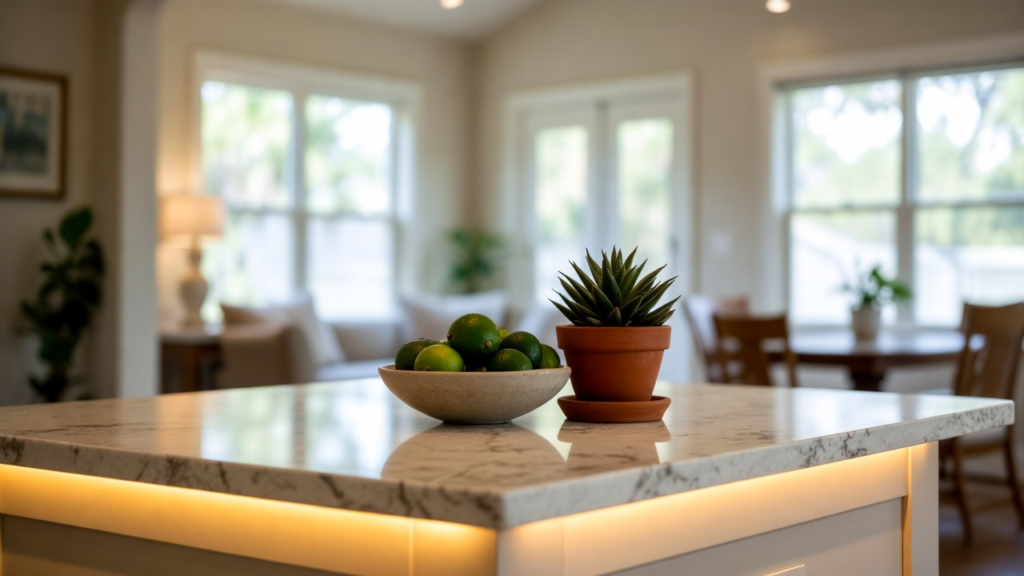
- Clear every countertop completely. Everything you use every day comes off. All of it. What goes back is one or two intentional pieces: a bowl of fresh lemons, a small herb plant in a clean pot, or a single cookbook open on a stand. That’s it. Buyers don’t want to see your kitchen; they want to imagine theirs.
- Clean appliances beyond what you think is necessary: Stainless steel fingerprints photograph harshly. Clean every appliance face with a proper stainless steel cloth. Pull the stovetop grates and clean underneath. Wipe the interior of the microwave.
- Deal with the details that accumulate in Tampa: Cabinet fronts, range hoods, faucets, and tile backsplashes all need a thorough wipe-down with a proper degreaser, not just a damp cloth.
The Living Room: Spacious, Neutral, and Ready for Imagination
The goal of a staged living room is not to look beautiful. The goal is to look like it could be anyone’s beautiful living room.
The moment a buyer sees your personal taste; your gallery wall of family photos, your collection of sports memorabilia, your eclectic throw pillow situation, they’re reminded that this is someone else’s home. That subtle signal makes them visitors rather than future owners. Remove it.
Strip the room back to its furniture layout, then add back only neutral styling: coordinating cushions in two or three colors, a single folded throw, a coffee table book or a simple vase.
Then step back and ask whether the room feels like it has breathing room. If it feels tight, remove another piece of furniture entirely for the shoot.
Bedrooms: The Quietest Rooms That Do the Most Emotional Work
Bedrooms sell a feeling more than any other room in the home. Buyers looking at a bedroom photo are imagining sleep, rest, and private life. They need the room to feel calm, clean, and aspirational.
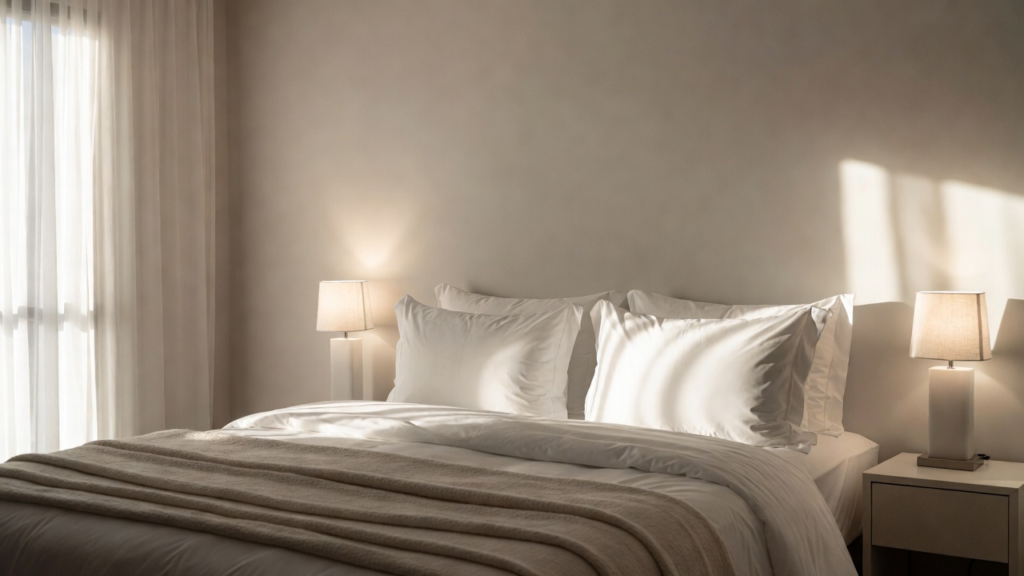
Make the bed as if you’re staying in the best hotel you’ve ever been in. Use your crispest, cleanest white or neutral bedding. Layer it: duvet, shams, two standard pillows in matching cases. Keep it perfectly symmetrical. This is the single highest-return staging task in the entire home, and it costs nothing.
Remove everything from nightstands except one lamp and one small item per side.
In Tampa Bay homes, where bedrooms often double as home offices or Florida room alternatives, be ruthless about anything that signals work or storage. A desk that can’t be removed should at least be completely cleared. A closet that’s visible should be organized well enough to show.
Bathrooms: Small Rooms With a Big Impact
Bathrooms are where buyer skepticism peaks. They look closely here because bathrooms reveal how a home has been maintained.
Take everything off every surface; counter, ledge, shower shelf, toilet tank top. Every product, every candle, every decorative item you’ve had in there. Start completely empty and add back only one or two intentional pieces: a set of rolled white towels in a basket, a single orchid on the counter, a clean soap dispenser that matches the faucet finish.
Address what Tampa’s water does to bathrooms. The mineral content in local water supply leaves calcium deposits on faucets and glass shower doors that become very visible in professional photography. A lime scale remover applied the day before the shoot, followed by a proper polish of fixtures, makes a noticeable difference. The shower glass should be completely streak and soap scum free; squeegee it, then dry it with a microfiber cloth.
Replace towel sets with matching, fresh ones for the shoot. Fold them precisely. And close the toilet lid. Every time.
Outdoor Spaces: The Room Tampa Buyers Are Really Buying
In almost every other real estate market, outdoor staging is a secondary consideration. In Tampa Bay, it’s co-equal with anything inside the home. Buyers are coming here for the lifestyle; the warmth, the outdoor living, the pool. If the outdoor spaces don’t look the part, the listing loses its most powerful differentiator.
- The pool has to be immaculate
- Style the outdoor furniture like it’s a boutique resort
- For drone footage, the entire property needs to be cleaned from above

The Morning Checklist: Thirty Minutes Before the Photographer Arrives
Everything below should take thirty minutes or less if the prep work was done in the two days prior:
Turn on every light in the house; lamps, ceiling fixtures, under-cabinet lights, bathroom vanities, closet lights. Open every blind and curtain fully. Move all vehicles off the driveway and ideally off the front street. Remove all pet items, beds, bowls, crates, toys, from every room. Take out all trash bins, interior and exterior. Do one final pass of every surface. Fluff every cushion and pillow. Step outside, look at the front of the house as a stranger would, and fix anything that catches your eye.
Then step away and let the photographer do their job.
A Well-Staged Home Doesn’t Look Staged. It Looks Like Home.
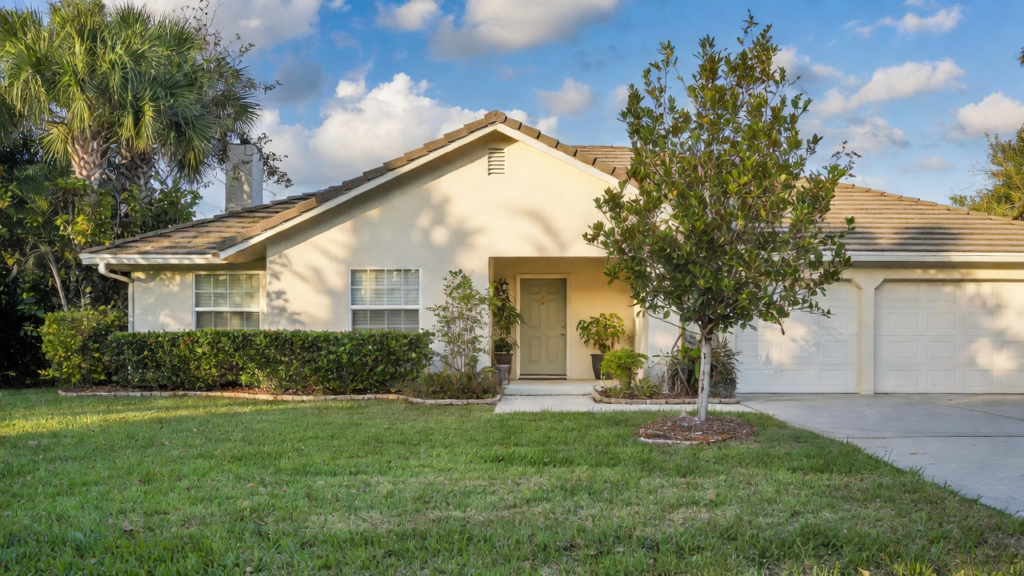
There’s a version of staging that feels performative; a home dressed up so carefully that it looks like no one actually lives there. That’s not what you’re going for. You’re going for something subtler: a home that feels cared for, spacious, and quietly aspirational. A home that makes a buyer in another city think, “I could live there.”
That feeling doesn’t come from expensive furniture or a professional stager. It comes from attention. It comes from clearing out what doesn’t belong, cleaning what the camera will amplify, and adding back the small touches that make a space feel intentional rather than incidental.
In Tampa Bay’s market, where a listing competes not just with the house down the street but with every comparable property a relocating buyer has bookmarked across the state, those details are the difference between a showing and a scroll.
Your home is worth more than a rushed staging job. Treat the photography day like the marketing event it is; because in this market, it’s the most important hour of the entire selling process.
Your home is staged and ready. Now it needs photography that does it justice.
We help Tampa Bay sellers and realtors create listing media that gets homes noticed, clicked on, and shown. Professional photography, drone coverage, video walkthroughs, and 3D tours, all in a single visit.
Book your real estate photography shoot → [Link to booking page]
Frequently Asked Questions
Q: How do I stage my Tampa home for real estate photography?
A: Begin two days before the shoot. The first day is for deep cleaning and decluttering every room; removing personal items, clearing countertops, and scrubbing anything the camera will pick up. The second day is for styling; fresh flowers, layered bedding, intentional decor touches. On the morning of the shoot, turn on all lights, open blinds, and move cars out of the driveway.
Q: Does home staging actually matter for listing photos in Tampa Bay?
A: More than most sellers expect. In a market where a significant number of buyers are relocating from out of state, listing photos are often the deciding factor before a showing is ever requested. Staging directly determines how those photos perform, and how quickly the home generates serious interest.
Q: What rooms are most important to stage for real estate photography?
A: The kitchen and master bedroom carry the most weight in buyer decisions and deserve the most preparation time. Bathrooms and outdoor living areas, especially pools are the next priority in Tampa Bay specifically, where buyers are highly attuned to maintenance and lifestyle features.
Q: What should I remove from my home before listing photos?
A: All personal photographs and memorabilia, every daily-use item from countertops, all toiletries from bathroom surfaces, every charging cable and cord, pet beds and bowls, trash bins, and any outdoor clutter visible in drone shots. The goal is to remove anything that makes the home feel specifically lived-in by someone else.
Q: How do I stage my pool area for Tampa real estate photos?
A: Clean the pool so the water photographs are clear and blue. Style patio furniture with clean, coordinating cushions. Add one or two potted tropical plants. Remove all outdoor clutter; hoses, toys, tools. Mow and edge within two days of the shoot, and move all vehicles out of the driveway before drone photography begins.
Q: Should I hire a professional stager or do it myself?
A: For occupied homes, self-staging with proper preparation is effective for most price points. For vacant homes or luxury listings, professional staging is worth the investment, empty rooms photograph poorly and buyers have difficulty gauging scale and lifestyle without furniture present.
Q: What lighting should I use for real estate photos in Tampa?
A: Turn on every artificial light source in the home, including lamps, under-cabinet lighting, and bathroom vanities. Open all blinds fully to maximize natural light. Tampa’s morning and late-afternoon light is ideal for exterior shots; discuss shoot timing with your photographer to take advantage of it.